Can a Free Subdomain Website Really Get You Direct Bookings?
Short answer: yes. Here's the honest truth about what a free OwnerWebs site can do, where it hits its limits, and when it's time to upgrade.
When you build your vacation rental website on OwnerWebs, you can now publish it live for free on your own subdomain, at an address like takemebacktoparadise.ownerwebs.site. Guests can visit it, check your calendar and send booking requests while you're still building.
That leads to a fair question: if I put all my effort into a free subdomain site, can it actually be successful?
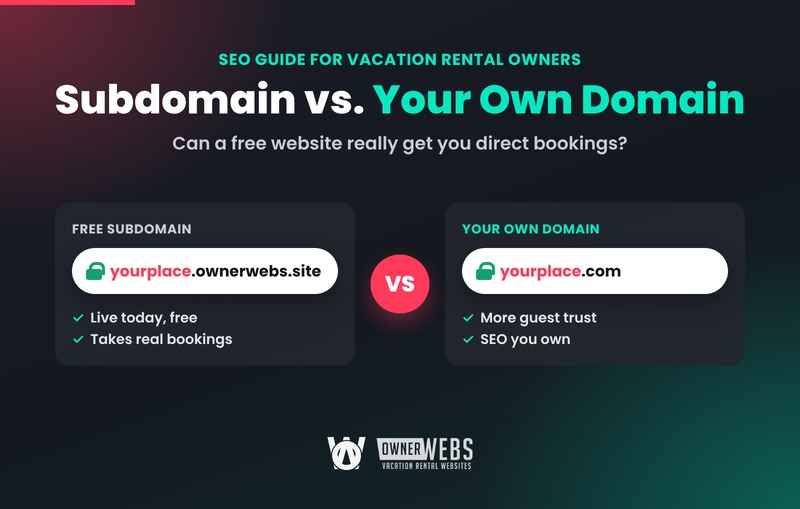
It can. But you should know exactly how it compares to having your own domain, like takemebacktoparadise.com, so you can decide what's right for you.
Where your direct bookings actually come from
Before talking about domains, it helps to know where direct bookings come from for most owners. For small vacation rental owners, Google search is usually not the biggest source. Most direct bookings come from:
- Repeat guests who loved their stay and want to come back
- Referrals from past guests telling friends and family
- Social media, such as Facebook posts, Instagram and local groups
- Your Google Business Profile, when people search for your property by name
- QR codes and cards left inside your rental
None of these care much what your web address says. A past guest who trusts you will book through any link you send them. For these guests, a free subdomain site works just as well as a .com.
Where a free subdomain site does well
Bringing back past guests. Your biggest opportunity is the guests who already stayed with you. Send them your site link, put it on a card in the rental, and let them book direct next time without platform fees. The subdomain doesn't get in the way.
Getting found for specific searches. Google can and does rank subdomain websites. Plenty of free websites show up in search results every day. Where you have a real chance is specific searches, such as:
- "lakefront cabin with boat dock Toledo Bend"
- "pet friendly beach house with private pool Orange Beach"
- "cabin near [your town] with hot tub"
A focused site with real photos, honest descriptions and a Google Business Profile linking to it can get found for searches like these.
Owners with one or two properties. If you're not ready to commit to a paid plan, a free site that's live and taking booking requests beats a half-finished site that nobody can see.
Where a free subdomain site hits its limits
You should know the trade-offs.
1. Trust with first-time guests. Booking direct already asks guests to trust someone outside the big platforms. A guest who found you for the first time and is about to pay a deposit may hesitate when the address is a long subdomain. A .com simply looks more established.
How to reduce this: use real photos, show your reviews, list your phone number, and link to your Google Business Profile.
2. Broad, competitive searches. For general searches like "Gulf Shores vacation rental," you're competing with huge travel sites and large management companies. A new site with few links won't win those searches, whatever its domain. That's true for most small owners on a .com too.
3. Your SEO builds on someone else's domain. As you collect links, mentions and search history, all of it builds up on ownerwebs.site instead of a domain that's yours. That's fine as long as you stay on the free site, and it doesn't become a loss when you upgrade, as explained below.
4. Harder to remember and say out loud. "Take me back to paradise dot ownerwebs dot site" is a mouthful on the phone, on a yard sign or on a business card. "Take me back to paradise dot com" is easy.
5. No branded email. With your own domain you can use an address like info@takemebacktoparadise.com, which tells guests you're a real business. A subdomain can't give you that.
What happens when you upgrade to your own domain
Moving from a free site to your own domain is often where owners lose everything they've built in search. With OwnerWebs, when you connect your own domain, your free subdomain automatically redirects to it.
That means:
- Guests who click your old link still land on your site
- Links you shared on Facebook, in QR codes and on your Google Business Profile keep working
- Google is told your site has moved, so the search progress you've built carries over to your new domain
Starting free doesn't cost you anything you've built.
So, can a free OwnerWebs site be successful?
Yes, especially if you:
- Have past guests you can bring back
- Share your site on social media and in groups
- Set up a Google Business Profile that links to your site
- Write real, specific descriptions of what makes your place special
- Use real photos and show your reviews
The domain is rarely what decides whether a direct booking website succeeds. What matters most is getting guests to your site and earning their trust once they're there.
A free subdomain site gets you started. Your own domain makes everything stronger: more trust with new guests, a name they'll remember, a branded email, and SEO that builds on something you own.
"Set it and forget it" is not a winning strategy
Here's the mistake we see more than any other: an owner builds a beautiful website, publishes it, and never touches it again.
A website that never changes tells Google there's nothing new to see. Guests notice too. Old rates, last year's photos and an "upcoming events" page from two summers ago make a guest wonder if anyone is still running the place.
Whether you're on a free subdomain or your own .com, the sites that win are the ones that keep growing.
Why adding content matters so much
Every new page is another way to be found. Your homepage can only rank for so many searches. A page about the best fishing spots near your cabin, a guide to local restaurants or a post about your area's fall festival can each show up for searches your homepage never would.
It answers the questions guests are already asking. Guests search for things like "what to do in Orange Beach in winter" or "is Toledo Bend good for families" long before they search for a place to stay. If your site has the answer, you meet them early, before the big booking sites do.
It builds trust. A guest reading your local tips, your story and your recent updates gets to know you before they book. That's something a listing on a big platform can't give them.
It gives you something to share. Every new post is a reason to email past guests, post on Facebook or share in a group, and every share sends people back to your site.
It keeps your site fresh. Search engines notice sites that are updated regularly. Fresh, useful content is one of the simplest signals that your site is alive and worth showing.
What to write about
You don't need to be a writer. You already know things guests want to know:
- Local guides: restaurants, beaches, trails, boat launches, grocery stores and hidden gems near your property
- Seasonal posts: what's happening in spring, summer, fall and winter, and why each season is worth a visit
- Events: festivals, fishing tournaments, holidays and concerts in your area
- Guest questions: answer the questions you get asked over and over, like parking, pets, check-in and what to pack
- Property updates: new furniture, a new hot tub, a fresh coat of paint, new photos
- Your story: why you bought the place, what you love about the area, what makes your rental different
Make it a habit, not a project
You don't need to write every day. One helpful post a month adds up to twelve new ways to be found in a year. Set a reminder, pick a topic from the list above, and spend an hour on it.
Update your photos when something changes. Refresh your rates before each season. Add new reviews as they come in.
The owners who get the most direct bookings aren't always the ones with the fanciest website. They're the ones who keep showing up.
The smart path for most owners
- Build your site free on OwnerWebs and see it live.
- Share it with past guests, on social media and on your Google Business Profile.
- Take your first direct bookings.
- Upgrade to your own domain when you're ready. Your links and search progress come with you, and every paid plan has 0% commission.
Your property. Your guests. Your website. Start free today at OwnerWebs.com.
Frequently Asked Questions
What’s the difference between a subdomain and my own domain?
Is a subdomain bad for SEO?
Can a free subdomain website really get direct bookings?
Will guests trust a subdomain website?
What happens to my SEO when I switch to my own domain?
Will the links I’ve already shared stop working?
Can I get a branded email address with a subdomain?
How often should I add new content to my website?
What should I write about on my vacation rental website?
When should I upgrade from a free subdomain to my own domain?

Matthew Thompson
Matthew Thompson is a licensed employing real estate broker in Louisiana and Colorado, with twenty years of experience in the vacation rental home industry. He holds a degree in Chemical Engineering from Louisiana Tech University and is also the developer and founder of OwnerWebs.com, a vacation rental website builder. View his professional profile